WMS Impact Estimator
Estimate how moving from manual processes or basic inventory tracking to a dedicated WMS can improve your supply chain efficiency. Enter your current metrics below.
Current Operations Data
Enter your data to see estimated savings and efficiency gains.
Estimated Annual Impact
Operational Improvements
You’ve probably heard people throw around terms like WMS and supply chain as if they’re interchangeable. They aren’t. But here’s the kicker: you can’t have a modern, efficient supply chain without one. If you’re running a business that moves physical goods, understanding exactly where Warehouse Management Systems fit into the bigger picture isn’t just academic-it’s the difference between shipping on time and drowning in backorders.
Think of your supply chain as a human body. The suppliers are the heart, pumping raw materials in. Transportation is the circulatory system, moving blood (goods) to where it’s needed. And the warehouse? That’s the liver or the stomach-a processing hub where things get sorted, stored, and prepped for distribution. A Warehouse Management System is the nervous system for that specific organ. It doesn’t run the whole body, but if it fails, the organ shuts down, and eventually, so does the rest of you.
The Short Answer: Yes, But With Nuance
Is WMS part of the supply chain? Absolutely. In fact, it’s a critical execution layer within it. While the broader supply chain encompasses everything from sourcing raw materials to delivering the final product to the customer’s doorstep, the WMS handles the middle mile-the storage and movement of inventory within your four walls.
Many business owners confuse Supply Chain Management (SCM) software with WMS. Here’s the distinction: SCM looks outward and upstream/downstream. It manages relationships with vendors, forecasts demand, and plans production. WMS looks inward. It tells a picker which bin to go to, verifies that the right item was scanned, and updates stock levels in real-time. One plans; the other executes. You need both, but they do very different jobs.
Where WMS Fits in the Logistics Stack
To really grasp the role of a WMS, you have to look at the typical technology stack in a mid-to-large enterprise. It usually looks like this hierarchy:
- ERP (Enterprise Resource Planning): The brain. Handles finance, HR, procurement, and high-level order data. Examples include SAP, Oracle NetSuite, or Microsoft Dynamics.
- TMS (Transportation Management System): Manages the freight carriers, route optimization, and shipping costs outside the warehouse.
- WMS (Warehouse Management System): Manages the inventory location, labor tasks, and picking strategies inside the facility.
- OMS (Order Management System): Often sits between ERP and WMS, deciding which warehouse should fulfill which order based on proximity and stock availability.
In this ecosystem, the WMS is not an island. It’s deeply integrated. When an order hits your OMS, it pushes details to the WMS. The WMS then guides your staff to pick, pack, and ship. Once shipped, the WMS sends confirmation back to the ERP to trigger invoicing. If any link in this chain breaks, your supply chain suffers. A disconnected WMS means your sales team thinks you have stock when you don’t, leading to overselling and angry customers.
Why Your Supply Chain Fails Without Proper WMS Integration
Let’s get concrete. Imagine you’re selling custom furniture online. Your supplier in Vietnam ships components to your UK warehouse. Without a robust WMS, here’s what happens:
- Receiving Chaos: Goods arrive in mixed containers. Staff manually count them. Errors happen. Inventory records say you have 100 units; you actually have 98 because two were damaged.
- Picking Inefficiency: Pickers wander the aisles looking for items because there’s no directed pathing. They pick wrong items because similar SKUs are stored next to each other.
- Shipping Delays: Orders pile up because packing stations don’t know what’s ready. Carriers leave before cutoff times because labels weren’t generated in time.
A WMS solves these by enforcing processes. It uses barcode scanning to verify every move. It optimizes travel paths for pickers. It integrates with carrier APIs to generate labels instantly. This precision reduces error rates-often from 3-5% down to less than 0.1%. In a high-volume operation, that’s thousands of dollars saved in returns and expedited shipping fees.

Key Functions That Bridge WMS and Supply Chain Success
A standalone spreadsheet isn’t a WMS. A true WMS offers features that directly impact supply chain performance metrics. Here are the heavy hitters:
| WMS Feature | Supply Chain Benefit | Metric Improvement |
|---|---|---|
| Real-Time Inventory Visibility | Prevents stockouts and overstocking | Reduces carrying costs by 10-20% |
| Directed Putaway & Picking | Optimizes space and labor efficiency | Increases pick rates by 25-40% |
| Batch & Serial Tracking | Ensures compliance and traceability | Speeds up recall response time by 90% |
| Labor Management | Balances workload across shifts | Improves employee utilization by 15% |
Notice how none of these features exist in a vacuum. Real-time visibility feeds into your demand planning. Efficient picking lowers your cost per order, allowing you to compete on price or offer faster delivery. Traceability protects your brand reputation. These are supply chain outcomes driven by warehouse tools.
Common Misconceptions About WMS Scope
There’s a myth that WMS is only for giant warehouses with conveyor belts and robotic arms. Not true. Even a small e-commerce seller using Shopify and a basic cloud-based WMS benefits from better inventory accuracy. Another misconception is that once you implement a WMS, your work is done. Wrong. A WMS requires constant tuning. Slotting (where items are placed) needs to change seasonally. Labor standards need updating as staff learn the system. Neglecting maintenance turns a powerful tool into a rigid bottleneck.
Also, don’t confuse WMS with Inventory Management Software (IMS). IMS tracks quantities. WMS tracks locations and movements. You might know you have 50 red shirts, but IMS won’t tell you they’re split between Bin A12 and Bin Z4. That knowledge matters when you’re trying to pack orders quickly.
How to Choose the Right WMS for Your Supply Chain Stage
Selecting a WMS depends on your complexity level. Use this quick heuristic:
- Startup (Under 100 orders/day): Stick with native platform plugins (e.g., Shopify apps, Amazon FBA integrations). Don’t over-engineer. Focus on basic stock syncing.
- Growth (100-1,000 orders/day): Move to a dedicated cloud WMS (like ShipHero, Extensiv, or Cin7). You need multi-location support, batch tracking, and API connections to your accounting software.
- Enterprise (1,000+ orders/day): Consider on-premise or hybrid solutions (Manhattan Associates, Blue Yonder, SAP EWM). You’ll need advanced wave planning, automation integration, and complex labor modeling.
When evaluating vendors, ask one question above all others: "How does your system handle exceptions?" Normal operations are easy. What happens when a shipment arrives late? When a customer cancels after picking has started? When a supplier sends the wrong SKU? Your supply chain resilience is defined by how well your WMS manages these edge cases.
The Future: AI and Automation in Warehouse Operations
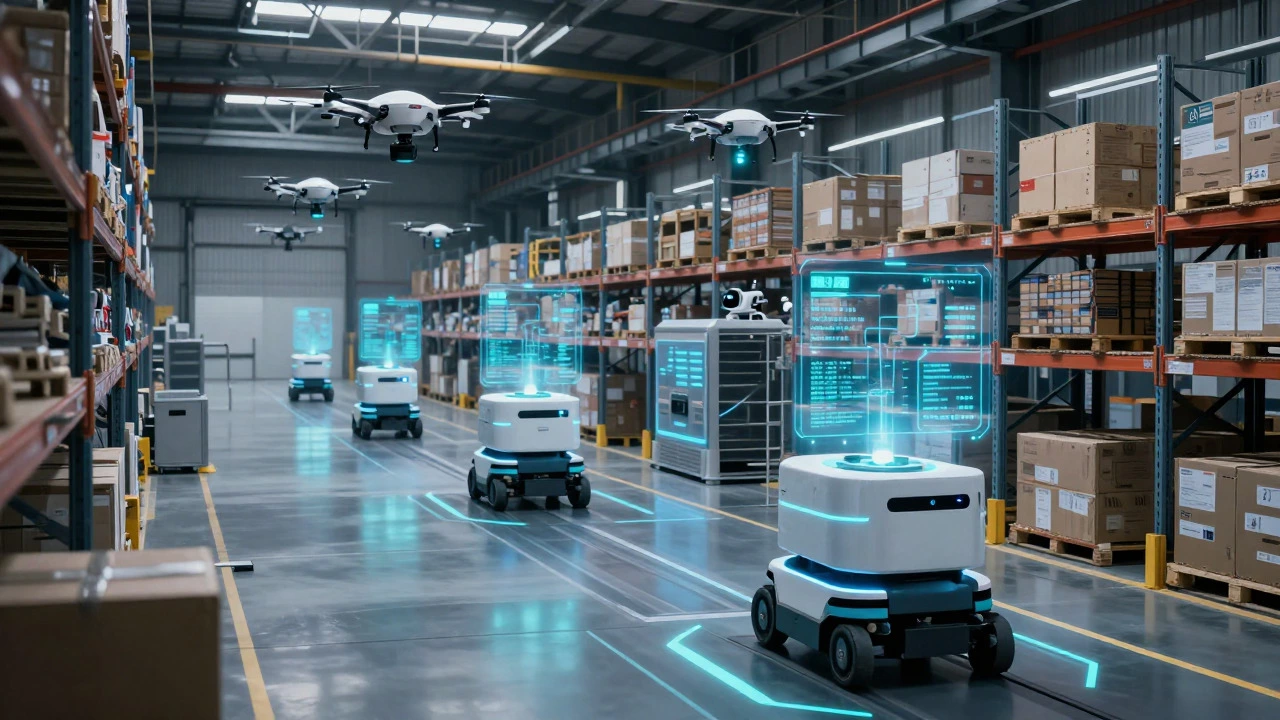
As we look toward 2026 and beyond, the line between WMS and supply chain intelligence is blurring further. Modern systems are incorporating Artificial Intelligence to predict congestion. For example, some WMS platforms now analyze historical data to suggest optimal putaway locations based on predicted future demand, not just current velocity. This proactive approach reduces future travel time for pickers.
Integration with IoT devices is also accelerating. Sensors on shelves can report low stock automatically, triggering replenishment tasks without human input. Drones are being used for cycle counting, updating inventory records in minutes instead of days. These technologies turn the warehouse from a static storage unit into a dynamic node in the supply network.
Ultimately, viewing WMS as merely "software for the warehouse" undersells its strategic value. It is the operational backbone that ensures your supply chain promises-fast delivery, accurate orders, reliable stock-are kept. Ignore it, and your supply chain leaks money and trust. Master it, and you gain a competitive edge that’s hard to replicate.
What is the main difference between WMS and ERP?
An ERP (Enterprise Resource Planning) system manages overall business processes like finance, HR, and procurement, providing a holistic view of the company. A WMS (Warehouse Management System) focuses specifically on managing daily warehouse operations such as receiving, putting away, picking, packing, and shipping inventory. While an ERP knows *what* you have and *how much* it cost, a WMS knows *exactly where* it is located and *how efficiently* it can be moved.
Can I use a WMS without an ERP?
Yes, especially for smaller businesses. Many cloud-based WMS platforms offer built-in inventory management, order processing, and even basic accounting features, effectively replacing the need for a separate ERP. However, as your business grows and financial reporting becomes more complex, integrating a dedicated WMS with a robust ERP is often necessary for comprehensive business oversight.
Does a WMS help with international shipping?
Directly, no; indirectly, yes. A WMS itself doesn't book flights or handle customs clearance-that's typically the job of a TMS (Transportation Management System) or a freight forwarder. However, a WMS ensures that goods are correctly labeled, packed according to international regulations, and documented accurately before they leave the warehouse. Accurate weight and dimension data captured by the WMS is crucial for calculating international shipping costs and avoiding customs delays.
How long does it take to implement a WMS?
Implementation timelines vary significantly based on complexity. A simple, cloud-based WMS for a single-location small business can be set up in 2-4 weeks. Mid-sized companies with multiple locations and moderate integrations typically require 3-6 months. Large enterprises implementing complex, customized solutions with extensive hardware integration (conveyors, AS/RS) may face timelines of 9-18 months or longer due to testing, training, and data migration requirements.
Is WMS suitable for dropshipping businesses?
Traditional WMS functionality is less relevant for pure dropshippers since they don't hold physical inventory. However, many dropshippers still use lightweight inventory sync tools that mimic WMS logic to prevent overselling. If a dropshipper begins holding some fast-moving SKUs in-house (hybrid model), a basic WMS becomes valuable for managing those specific internal stocks while continuing to automate third-party fulfillment for the rest.