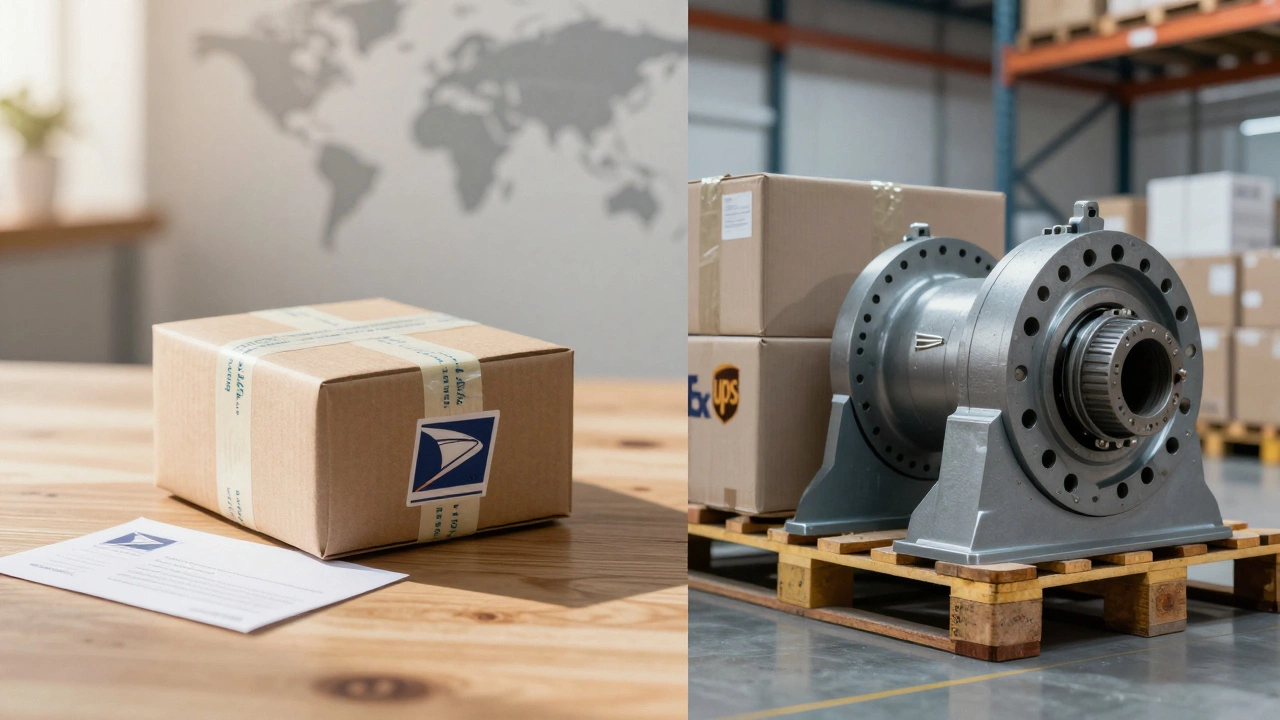
There is no single "best" mail carrier for international shipping. The right choice depends entirely on what you are sending, where it is going, and how fast you need it to arrive. If you are mailing a lightweight letter to France, one carrier will save you money. If you are shipping heavy machinery to Brazil, another carrier will handle the logistics better.
Most shippers in the United States choose between four major players: USPS (United States Postal Service), the national postal service known for affordable small-package rates and universal reach, UPS (United Parcel Service), a private courier giant offering reliable tracking and extensive global networks, FedEx (Federal Express), an air-freight leader specializing in time-sensitive shipments and express delivery, and DHL Express (Deutsche Post DHL Group), a German-based logistics powerhouse with superior customs clearance capabilities outside North America.
Key Takeaways
- For lightweight packages under 4 lbs: USPS Global Express Guaranteed or Priority Mail International is usually the most cost-effective option.
- For heavy packages over 10 lbs: UPS and FedEx often provide better per-pound rates than USPS.
- For speed and reliability: DHL Express dominates non-North American routes; FedEx and UPS lead within North America and to Europe.
- For customs clearance: DHL has the highest success rate in complex markets like Southeast Asia and Africa due to its local presence.
- Always compare quotes: Rates fluctuate weekly based on fuel surcharges and zone pricing. Use online calculators before deciding.
How to Choose the Right Carrier for Your Needs
Before comparing prices, you must define your priority. Are you trying to minimize cost, maximize speed, or ensure safe handling? Each carrier excels in different areas. Understanding these strengths helps you avoid costly mistakes, such as choosing a cheap service that gets stuck in customs for weeks.
| Carrier | Best For | Weakest Area | Global Reach |
|---|---|---|---|
| USPS | Small, light packages; documents | Heavy freight; real-time tracking abroad | Universal (via partner posts) |
| UPS | Heavy packages; business-to-business | Very small envelopes (can be pricey) | Extensive (220+ countries) |
| FedEx | Urgent documents; mid-weight parcels | Rural delivery in remote regions | Extensive (220+ countries) |
| DHL Express | Non-US destinations; customs-heavy regions | Domestic US shipping (uses partners) | Superior outside North America |
USPS: The Budget-Friendly Option for Small Shipments
The United States Postal Service remains the go-to choice for individuals and small e-commerce sellers shipping lightweight items. Unlike private couriers, USPS does not charge residential delivery fees, which can add $3-$5 to every package from UPS or FedEx. This makes USPS significantly cheaper for small orders.
USPS offers two main international services: Priority Mail International and First-Class Package International Service. First-Class is ideal for items under 4 lbs (1.8 kg). It is inexpensive but lacks detailed tracking once the package leaves the U.S. Customs facility. You might see it scanned at departure, but then silence until it arrives in the destination country.
Priority Mail International provides better tracking and insurance options. Delivery times range from 6 to 20 business days depending on the destination. While slower than express options, it is often half the price of UPS or FedEx for similar weights. However, if your package weighs more than 10 lbs, USPS rates jump sharply. At that point, private carriers become more competitive.
UPS: Reliability for Heavy and Commercial Shipments
UPS (United Parcel Service) is built for volume and weight. If you are shipping boxes heavier than 15 lbs, UPS often beats USPS on price. Their rate structure favors density and distance differently than postal services. They also offer robust tracking systems that update frequently throughout the journey, including during customs processing.
UPS Worldwide Express and UPS Worldwide Saver are popular choices for businesses needing guaranteed delivery dates. These services include pre-paid duties and taxes in some cases, simplifying the experience for recipients. UPS has a vast network of hubs worldwide, allowing them to handle large volumes efficiently. However, their customer service can be impersonal, and claims for lost or damaged goods require thorough documentation.
FedEx: Speed and Air Freight Expertise
FedEx specializes in air transport. If time is critical, FedEx is often the fastest option, especially for mid-weight packages (5-20 lbs). Their FedEx International Priority service guarantees next-day or two-day delivery to many major cities globally. This reliability comes at a premium, but for high-value items or urgent documents, the peace of mind is worth the extra cost.
FedEx also excels in handling fragile or valuable items due to its dedicated cargo planes and controlled environments. They offer comprehensive insurance coverage up to $100,000 per shipment without requiring third-party policies. One drawback is that FedEx’s ground network is less extensive than UPS’s in rural areas, which might affect final-mile delivery times in remote locations.
DHL Express: The King of Non-North American Routes
If you are shipping anywhere outside the United States and Canada, DHL Express deserves serious consideration. As part of Deutsche Post DHL Group, DHL operates its own aircraft and has deep local partnerships in Europe, Asia, Africa, and South America. This gives them an edge in customs clearance, which is often the biggest bottleneck in international shipping.
DHL’s proprietary software predicts customs delays and prepares documentation proactively. In countries with complex import regulations, such as India or Nigeria, DHL’s success rate for smooth clearance is higher than competitors’. However, DHL does not operate its own last-mile delivery network within the U.S. Instead, they partner with local carriers, which can sometimes lead to inconsistent tracking updates domestically.
Cost Comparison: Real-World Examples
To illustrate the differences, let’s look at hypothetical scenarios. Prices vary by zone, so these are estimates based on average rates in 2026.
- Scenario 1: A 2 lb book sent to London.
- USPS First-Class International: ~$15
- UPS Worldwide Expedited: ~$35
- FedEx International Economy: ~$32
- DHL Express Worldwide: ~$40
- Scenario 2: A 15 lb box of electronics sent to Tokyo.
- USPS Priority Mail International: ~$95
- UPS Worldwide Express: ~$75
- FedEx International Priority: ~$70
- DHL Express Worldwide: ~$65
- Scenario 3: A 50 lb machine part sent to São Paulo.
- USPS Priority Mail International: ~$250
- UPS Worldwide Express: ~$180
- FedEx International Priority: ~$175
- DHL Express Worldwide: ~$160
Note that DHL becomes increasingly cost-effective as weight increases and destinations move further from North America. USPS loses competitiveness quickly above 10 lbs.

Customs Clearance: The Hidden Challenge
International shipping isn’t just about moving boxes; it’s about navigating bureaucracy. Every country has unique import rules, duties, and taxes. Failure to comply can result in seized packages, fines, or returns.
All major carriers require accurate commercial invoices. You must declare the contents, value, and reason for export (gift, sale, sample, etc.). Misdeclaring value to save on duties is illegal and risky. Carriers like DHL and UPS have dedicated customs brokerage teams that help resolve issues. USPS relies on the recipient’s local post office, which may lack resources to handle complex queries.
Pro tip: Always mark gifts clearly if applicable, but understand that many countries tax gifts above certain values. Provide detailed descriptions (e.g., “Cotton T-Shirt” instead of “Clothing”) to speed up inspection.
Tracking and Customer Support
Visibility matters when sending items overseas. USPS tracking is basic outside the U.S. Once handed off to the destination postal service, updates may stop. UPS, FedEx, and DHL provide end-to-end tracking with estimated delivery dates and exception alerts (e.g., weather delays, address issues).
Customer support quality varies. FedEx and UPS offer 24/7 phone and chat support with multilingual agents. DHL’s support is strong in international markets but weaker in the U.S. USPS support is limited, often requiring visits to local post offices for resolution.
Insurance and Liability
Lost or damaged packages happen. All carriers offer basic liability, but it is minimal. USPS includes up to $100 coverage for international Priority Mail. UPS and FedEx offer higher limits but charge additional fees for full value protection. Consider purchasing third-party insurance for high-value items exceeding $500. Ensure the policy covers both loss and damage during transit.
Final Recommendations Based on Use Case
Choosing the best carrier requires matching your specific needs to each provider’s strengths. Here is a quick guide:
- Individuals sending letters/small gifts: Use USPS First-Class International for affordability.
- E-commerce sellers shipping under 4 lbs: Compare USPS Priority Mail International with UPS/FedEx economy services. Often USPS wins on price.
- Businesses shipping heavy/bulky items: Choose UPS or FedEx for better per-pound rates and reliable tracking.
- Ships to Europe/Asia/Africa: Prioritize DHL Express for faster customs clearance and competitive rates.
- Urgent documents: FedEx International Priority or DHL Express Worldwide offer next-day options.
Remember to always use online rate calculators from each carrier before finalizing your choice. Input exact dimensions, weight, and destination zip code/postal code for accurate comparisons. Fuel surcharges and dimensional weight calculations can significantly impact final costs.
Is USPS cheaper than UPS for international shipping?
Yes, for lightweight packages under 4 lbs, USPS is generally cheaper than UPS. However, for packages over 10 lbs, UPS often becomes more cost-effective due to different pricing structures. Always compare quotes for your specific weight and destination.
Which carrier has the best tracking for international packages?
UPS, FedEx, and DHL provide superior end-to-end tracking compared to USPS. USPS tracking often stops once the package enters the destination country's postal system. Private couriers maintain visibility through their own networks or integrated partner systems.
Does DHL ship from the USA?
Yes, DHL Express ships from the USA to over 220 countries. However, for domestic U.S. deliveries, DHL partners with other carriers like FedEx or UPS because it does not operate its own last-mile network within the United States.
What is the fastest way to send a package internationally?
FedEx International Priority and DHL Express Worldwide offer next-day or two-day delivery to many major global cities. USPS Global Express Guaranteed is also a fast option, typically delivering in 1-3 business days, but availability depends on the destination.
Who handles customs clearance better: USPS or private carriers?
Private carriers like DHL, UPS, and FedEx generally handle customs clearance more efficiently. They have dedicated brokerage teams and proactive documentation processes. USPS relies on the destination country's postal service, which can lead to delays if paperwork is incomplete or questions arise.
Can I ship prohibited items internationally?
No, all carriers strictly prohibit hazardous materials, weapons, perishables (without special approval), and counterfeit goods. Regulations vary by country, so check both U.S. export laws and the destination country's import restrictions before packing. Attempting to ship prohibited items can result in fines or legal action.
How do I calculate dimensional weight for international shipping?
Dimensional weight is calculated by multiplying length x width x height (in inches) and dividing by a divisor (usually 166 for international air freight). Carriers charge based on whichever is greater: actual weight or dimensional weight. Use smaller boxes to reduce volumetric weight charges.
Is it worth buying extra insurance for international packages?
Yes, for items valued over $100. Basic carrier liability is limited and difficult to claim. Third-party insurance providers often offer better coverage ratios and easier claim processes. Ensure your policy covers theft, damage, and loss during transit.