
E-commerce CRM Impact Calculator
Business Inputs
Projected Monthly Impact
| Metric | Without CRM | With CRM | Impact |
|---|---|---|---|
| Returning Revenue | $0 | $0 | +$0 |
| Support Costs | $0 | $0 | -$0 |
| Total Net Benefit | - | - | $0 |
Why this happens:
- Retention: CRM data allows for personalized re-engagement emails, reducing churn.
- Logistics: Automated "Out for Delivery" SMS/Emails reduce "Where is my order?" calls by up to 30%.
- Efficiency: Unified customer profiles speed up agent resolution time.
Enter your business metrics to see how a CRM could impact your bottom line.
You have a beautiful online store. Your products are top-tier, and your shipping rates are competitive. Yet, customers keep churning after their first purchase. They forget where their order is. They can't find the right size for their next buy. They feel like just another transaction number. This disconnect usually isn't about the product; it's about the relationship. In the world of e-commerce, that relationship is managed by something called CRM. But what exactly is CRM in e-commerce, and why does it matter more now than ever before?
At its core, Customer Relationship Management (CRM) is a system for managing all your company's relationships and interactions with customers and potential customers. In e-commerce, it’s not just a digital address book. It is the central nervous system that connects marketing, sales, and-crucially for this context-logistics. It turns scattered data points into a coherent story about who your customer is, what they want, and how you can deliver it to them efficiently.
The Core Function: More Than Just Contact Info
Many people mistake a CRM for a simple spreadsheet of names and emails. That’s a recipe for failure. A modern e-commerce CRM aggregates data from multiple touchpoints. When a customer browses your site, adds an item to their cart, abandons it, buys it, receives it, and then returns it, every single action feeds into the CRM.
This creates a unified customer profile. Instead of seeing "John Doe bought a shirt," the CRM tells you, "John Doe bought a medium blue shirt on Tuesday, received it via express delivery, and emailed support three days later asking about fabric care." This depth of insight allows you to personalize communication. You aren't guessing what John likes; you know.
In the context of logistics, this data is gold. If the CRM knows John prefers eco-friendly packaging or always orders by Friday for weekend use, you can tailor the fulfillment process accordingly. The CRM acts as the bridge between the front-end shopping experience and the back-end operational reality.
Why CRM is Critical for E-commerce Logistics
The title of this article might seem odd if you think of CRM solely as a marketing tool. However, in e-commerce, logistics and customer satisfaction are inseparable. Here is how CRM directly impacts the physical movement of goods:
- Predictive Inventory Placement: By analyzing purchase history within the CRM, you can predict regional demand spikes. If the CRM shows a surge in winter coat purchases in Chicago, your warehouse management system (WMS) can pre-position stock closer to that region, reducing last-mile delivery times.
- Automated Communication: Customers hate chasing updates. A CRM integrated with your shipping provider can trigger automated SMS or email notifications at every stage: "Packed," "Shipped," "Out for Delivery," and "Delivered." This reduces customer service tickets by up to 30%.
- Returns Management: Returns are a logistical nightmare. A CRM flags high-return customers or specific product issues. If a certain shoe size consistently gets returned due to fit, the CRM alerts the merchandising team to update size guides, preventing future reverse logistics costs.
- Personalized Shipping Options: High-value customers identified by the CRM can be offered free expedited shipping automatically at checkout, while budget-conscious shoppers see standard options. This optimizes your carrier contracts and customer satisfaction simultaneously.
Without a CRM, these processes are manual, error-prone, and slow. With a CRM, they become automated, accurate, and scalable.
Key Features of an E-commerce CRM
Not all CRMs are created equal. For an e-commerce business, especially one focused on efficient logistics, you need specific capabilities. Here are the non-negotiable features:
- Integration Capabilities: The CRM must talk to your e-commerce platform (like Shopify, Magento, or WooCommerce), your warehouse management system (WMS), and your shipping carriers (FedEx, UPS, DHL). Siloed data is useless data.
- 360-Degree Customer View: You should be able to see a customer’s entire journey in one dashboard. This includes past orders, support tickets, browsing behavior, and current location for targeted ads.
- Automation Workflows: Set rules to automate repetitive tasks. For example, if a customer hasn’t purchased in 90 days, automatically send a re-engagement email with a discount code. Or, if an order is delayed, automatically notify the customer before they contact you.
- Analytics and Reporting: Track key metrics like Customer Lifetime Value (CLV), Churn Rate, and Net Promoter Score (NPS). These metrics help you understand the health of your customer base and forecast demand for inventory planning.
- Omnichannel Support: Manage interactions across email, social media, live chat, and phone calls from a single interface. Consistency builds trust.
| Feature | Cloud-Based CRM | On-Premise CRM |
|---|---|---|
| Setup Time | Days to weeks | Months |
| Cost Structure | Subscription (SaaS) | High upfront license + maintenance |
| Scalability | High (add users easily) | Low (requires hardware upgrades) |
| Integration Ease | Easy (APIs available) | Complex (custom development needed) |
| Data Security | Provider-managed | Self-managed |
For most e-commerce businesses, especially those scaling rapidly, cloud-based CRMs are the superior choice. They offer flexibility, lower initial costs, and easier integration with modern logistics tools.
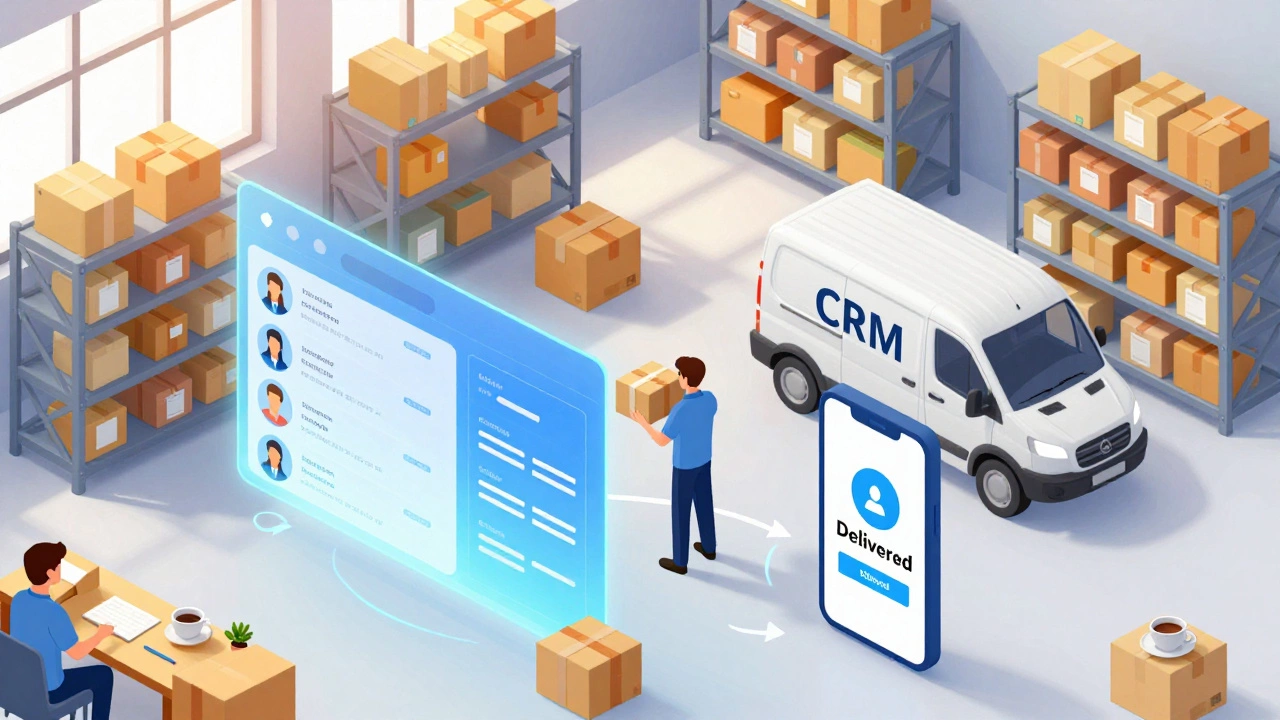
How CRM Improves Customer Retention
Acquiring a new customer is five to twenty-five times more expensive than retaining an existing one. This is a well-known statistic in marketing, but it has profound implications for logistics. Retained customers often have predictable ordering patterns, which simplifies inventory forecasting and route optimization.
A CRM helps retention through personalization. Imagine receiving an email that says, "Hi Sarah, we noticed your running shoes are six months old. Based on your average mileage, it might be time for a replacement. Here’s a 10% discount on our latest models, ready to ship to your home address on file."
This message works because it uses data (purchase date, product type) to provide value (timely reminder, convenience). It feels helpful, not spammy. Furthermore, by having the address on file, you reduce friction at checkout, leading to higher conversion rates. The CRM ensures that the logistics team knows exactly where to send the package without requiring the customer to re-enter details, speeding up the fulfillment process.
Segmentation is another powerful tool. You can group customers based on behavior: "VIP Buyers," "Cart Abandoners," "First-Time Shoppers," or "International Customers." Each segment receives tailored communication. VIPs might get early access to sales, while international customers receive clear information about customs duties and delivery timelines. This clarity reduces anxiety and prevents negative reviews related to unexpected fees or delays.
Integrating CRM with Logistics Systems
The magic happens when your CRM talks to your logistics stack. This integration creates a seamless flow of information from the moment a customer clicks "Buy" to the moment they sign for the package.
Here is a typical workflow:
- Order Placement: Customer places an order on your website. The order details (items, quantity, shipping address, payment method) are sent to your e-commerce platform.
- CRM Update: The CRM records the sale, updates the customer’s lifetime value, and triggers a welcome email.
- Warehouse Notification: The order is pushed to your Warehouse Management System (WMS). Pickers receive instructions to gather the items.
- Shipping Label Generation: Once packed, the WMS generates a shipping label via your preferred carrier. Tracking numbers are created.
- CRM Sync: The tracking number is sent back to the CRM. The CRM now knows the order status is "Shipped."
- Customer Notification: The CRM automatically sends an email/SMS to the customer with the tracking link.
- Delivery Confirmation: When the carrier marks the package as delivered, the CRM updates the status and may trigger a review request or a cross-sell email.
If any step fails-for example, if the address is invalid-the CRM can flag the issue immediately, allowing your customer service team to reach out proactively before the package bounces back to the warehouse. This proactive approach saves money on return shipping and preserves the customer relationship.

Choosing the Right CRM for Your Business
With hundreds of CRMs on the market, choosing the right one can be overwhelming. Start by assessing your business size and needs.
Small Businesses: If you’re just starting out, you need simplicity and affordability. Tools like HubSpot or Zoho CRM offer robust free or low-cost tiers with essential features like contact management, email automation, and basic reporting. They integrate well with major e-commerce platforms.
Mid-Sized Businesses: As you grow, you’ll need more advanced segmentation, multi-channel support, and deeper analytics. Salesforce Commerce Cloud or Microsoft Dynamics 365 might be suitable. These platforms offer greater customization and scalability but come with a steeper learning curve and higher cost.
Enterprise-Level: Large retailers require complex integrations with ERP systems, global logistics networks, and AI-driven insights. Solutions like SAP CX or Oracle CX provide enterprise-grade capabilities, including predictive analytics and omnichannel orchestration.
Regardless of size, prioritize integration. Ensure the CRM you choose has pre-built connectors for your e-commerce platform, shipping carriers, and warehouse systems. Custom integrations are possible but costly and time-consuming.
Common Pitfalls to Avoid
Implementing a CRM is not a plug-and-play solution. Many businesses make critical mistakes that undermine its effectiveness.
- Poor Data Hygiene: Garbage in, garbage out. If your CRM is filled with duplicate entries, outdated addresses, or incomplete profiles, your insights will be flawed. Regularly clean and deduplicate your data.
- Lack of Staff Training: A CRM is only as good as the people using it. Train your sales, marketing, and customer service teams on how to use the system effectively. Encourage them to log interactions consistently.
- Over-Automation: While automation is powerful, too much of it can feel robotic. Balance automated messages with personal touches. Use human agents for complex issues or high-value customers.
- Ignoring Mobile Users: Ensure your CRM workflows are optimized for mobile devices. Many customers interact with brands via smartphones, so your communications should look good and function well on small screens.
- Failing to Measure ROI: Track key performance indicators (KPIs) like conversion rate, customer retention rate, and average order value. Use this data to refine your strategies and justify the investment in CRM technology.
Avoiding these pitfalls ensures that your CRM becomes a strategic asset rather than a costly liability.
The Future of CRM in E-commerce
As technology evolves, so does CRM. Artificial Intelligence (AI) and Machine Learning (ML) are transforming how we interact with customers. AI-powered CRMs can analyze vast amounts of data to predict customer behavior with remarkable accuracy.
For instance, AI can identify customers likely to churn and suggest personalized interventions to win them back. It can also optimize pricing strategies in real-time based on demand and competitor activity. In logistics, AI can predict delivery delays due to weather or traffic and adjust routes dynamically.
Voice commerce is another emerging trend. As smart speakers become more prevalent, CRMs will need to integrate with voice assistants to capture and manage voice-based transactions. This requires new data structures and security protocols to protect sensitive information.
Furthermore, privacy regulations like GDPR and CCPA are becoming stricter. CRMs must ensure compliance by giving customers control over their data. Transparency builds trust, and trust drives loyalty. Future CRMs will likely feature built-in compliance tools to simplify this process.
Is CRM necessary for small e-commerce stores?
Yes, even small stores benefit from CRM. Basic CRMs help organize customer data, automate follow-ups, and improve retention. Many offer free tiers that are perfect for startups looking to scale efficiently without significant upfront costs.
How does CRM integrate with shipping carriers?
Most modern CRMs integrate with shipping carriers via APIs. When an order is shipped, the tracking number is automatically synced to the CRM, which then notifies the customer. This eliminates manual entry and ensures real-time visibility for both the business and the buyer.
Can CRM help reduce return rates?
Absolutely. By analyzing return reasons stored in the CRM, you can identify patterns such as sizing issues or product defects. You can then update product descriptions, improve quality control, or offer better pre-purchase guidance to prevent future returns.
What is the difference between CRM and ERP?
CRM focuses on external relationships with customers (sales, marketing, support), while ERP (Enterprise Resource Planning) manages internal operations (inventory, finance, HR). In e-commerce, they work together: CRM handles the customer interaction, and ERP handles the fulfillment and financial backend.
How long does it take to implement a CRM?
Implementation time varies. Simple cloud-based CRMs can be set up in days. Complex enterprise solutions with custom integrations may take months. Key factors include data migration, staff training, and integration with existing e-commerce and logistics platforms.